
Behavior-Driven Testing: The Complete Guide to BDT Automation
Yanir Taflev
Solution Engineering Lead
Behavior-driven testing (BDT) is a testing method in which the testing scenarios are based on user behavior. Often confused with BDD, BDT is based on the given-when-then structure, and enables better collaboration with the business and faster time-to-market. Let's see which additional advantages BDT offers developers, when to use it and the recommended BDT tools. But first, let's get a clearer picture of what BDT is.
What is Behavior-Driven Testing (BDT)?
Behavior-Driven Testing (BDT) is a software testing method that aims to test actual user behavior. Therefore, in BDT test scenarios are built according to the steps the user would take and not according to software functionality. In addition, BDT test scenarios are built in an understandable language. This enables clarity and communication with business stakeholders when creating and monitoring the tests. As a result, tests better reflect the users' needs and the features can be released and delivered faster. Like many types of software testing, BDT can be automated by implementing the tests into the CI/CD workflow.
BDT vs. BDD
Behavior-driven testing is often used interchangeably with behavior-driven development (BDD). However, they are not the same thing. Behavior-driven development is the software development approach that aims to develop software only according to user behavior. This helps avoid excessive code and unnecessary features. Like BDT, BDD is also based on conversations with business stakeholders and includes real user scenarios. However, unlike BDT, the goal of these discussions is for development, not for testing.
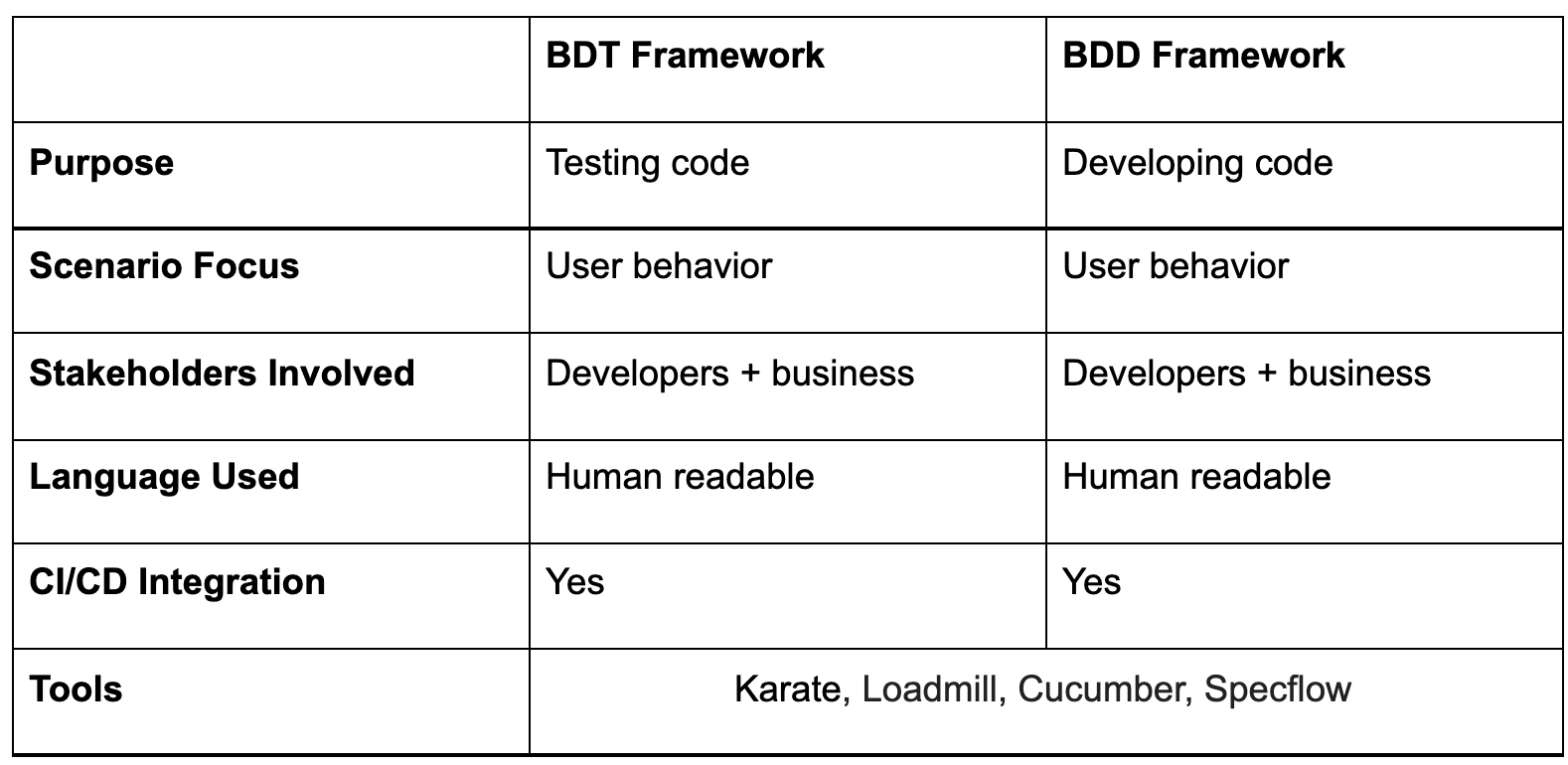
BDT Test Structure
The structure of BDT tests enables clearly understanding and defining the expected user behavior. Tests are divided into three parts:
Part 1 - The Context
This is the situation the user is in. For example, a user signed in, opened a webpage, or entered a string of characters.
Part 2 - The Event
The action the user took, which is being tested. For example, transferring money between accounts, creating a new entity, booking a flight, and more.
Part 3 - The Outcome
What is supposed to happen when the software functions correctly and the result is as expected. For example, the file downloads, a new page opens up, a form is submitted, etc.
A simpler way to remember this structure is "Given - When - Then".
Given the user signed in.
When the user clicks on a button.
Then a new page opens up.
To avoid confusion, it is recommended to test only one scenario per test.
4 Behavior-Driven Testing Advantages
1. Test Clarity
Behaviour-driven testing scenarios are built according to what the users will do in the product. As a result, when building the test scenarios, a lot of thought is put into what and what not to test, and what the expected results should be. This enables prioritization and creates clarity about the structure and purpose of the tests.
2. Collaboration Across the Organization
Using a simple logical structure (if-when-then) and human-readable language makes the tests and their logic easy to understand, both for developers and non-developers. This enables collaboration when discussing and writing tests.
3. Relevant Testing Scope
By prioritizing tests according to what the user will do, tests will cover most common use cases. This ensures relevancy and enables tests to be focused on what the user needs, as well as covering all edge-cases.
4. Enable Automation
BDT tests can be integrated into the CI/CD pipeline and run automatically according to a predefined schedule. This enables agility and ensures developers can focus on future development.
When to Use Behavior-Driven Testing
BDT with Integration Testing
Integration testing is the testing of different software modules together as a group, to ensure all modules can function together. BDT enables creating clear and accurate scenarios for these integrations, based on the users' behavior and in their language.
BDT with API Testing
A part of integration testing, API testing examines the functionality and reliability of the APIs in the business layer of the architecture. This makes BDT a really good fit for API testing. BDT scenarios enable clearly mapping each step into an API call that is being tested.
BDT for UI Testing? Consider rethinking
While some companies use BDT for UI testing, this is not a recommended best practice. The UI layer has multiple, complex scenarios. Each action could have thousands of outcomes. Even actions that seem similar could have a unique UI outcome, which would require a completely different set of tests.
Behavior-Driven Testing Recommended Tools
Cucumber
Cucumber is a popular BDT tool that uses Gherkin for writing tests. It reads executable specifications written in plain text and validates that the software does what those specifications say.
Karate
Karate is a Cucumber-based open source BDT framework for Java. It can be used for API testing, mocking, performance testing, and more.
SpecFlow
SpecFlow is an open-source BDT framework for .NET. It can be used for REST API testing, mobile automation, desktop automation, and more.
Loadmill
Loadmill's BDT approach solves the regression testing challenge by automatically creating regression tests based on real user behavior. These tests are created by analyzing thousands of user recordings from all kinds of sources and processing them into automated back-end tests.
Try Loadmill's Droid CUA
Turn Jira stories, epics, and plain-English requirements into executable flows across web and mobile platforms.
Download now