AI Testing Is Splitting Into Three Markets. Most People Are Still Talking About It Like It's One.
Kanika Pandey
VP Sales
I keep seeing AI testing discussed as if the whole category is moving in one direction. It isn’t. What is actually happening is much more interesting. The market is starting to split by architecture, and that matters because different industries break in different places.
If you are building for ecommerce, gaming, or digital SaaS, a lot of your quality risk is visible at the UI layer. Frontend changes are frequent, customer journeys are exposed, and when something breaks, you usually see it in the browser. In banking, insurance, healthcare, logistics, travel, and more complex enterprise environments, that is only part of the story. The screen may look perfectly fine while the workflow is already broken underneath. The failure is in the API handoff, the business rule, the event, the approval chain, or the downstream system that never updated.
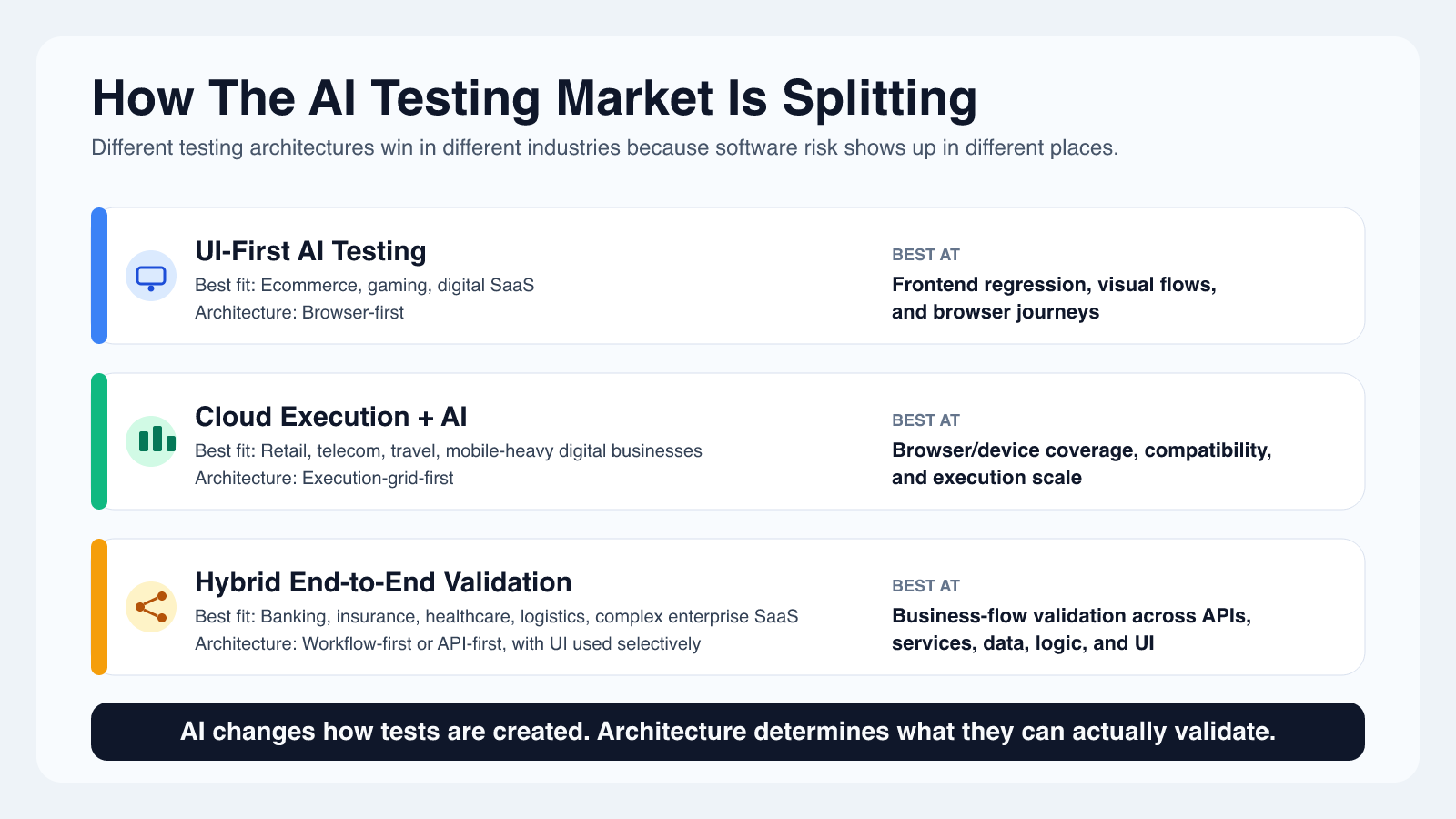
That is why I think the AI testing market is dividing into three real segments.
- UI-first AI testing
Best fit: ecommerce, gaming, digital SaaS, consumer apps.
Architecture: browser-first.
What it solves: frontend regression, browser workflows, customer-facing flows that break visibly at the interface.
Who is here: QA Wolf, Momentic, Functionize, mabl, Testsigma, and similar AI-native browser testing platforms. - Cloud execution plus AI
Best fit: retail, telecom, travel, mobile-heavy digital businesses.
Architecture: execution-grid-first.
What it solves: compatibility, device coverage, browser coverage, and execution at scale.
Who is here: BrowserStack, LambdaTest, Sauce Labs. - Hybrid end-to-end validation
Best fit: banking, fintech, insurance, healthcare, logistics, travel operations, enterprise SaaS with complex workflows.
Architecture: workflow-first or API-first, with UI used selectively where it adds value.
What it solves: failures across APIs, services, business logic, data movement, and UI together.
Who is here: Loadmill and the broader API-first or hybrid-testing end of the market.
This is where the conversation gets more serious. In a lot of enterprise environments, software does not fail because a button moved. It fails because the business workflow broke. A claim enters the system but does not progress correctly. A payment is initiated but does not reconcile. A customer gets through onboarding, but a backend rule silently fails. A booking looks successful in the UI but never lands in the right system. That is why I think hybrid end-to-end validation becomes more important over the next few years.
This is also why I do not think the biggest legacy platforms automatically define the next wave. They may remain large, but large platforms usually carry the architecture of the era they won. The last era rewarded rigid workflows, standardized assets, centralized governance, and tightly controlled execution models. The next era rewards something else: richer context, dynamic planning, faster iteration, and orchestration across systems. That does not mean the incumbents disappear. It means the question changes from who was biggest in testing to who is most native to the agentic model.
That is also why the word “agentic” on its own is not very useful anymore. What matters is what the agent actually does. Does it write browser tests? Heal failures? Generate code? Execute intent dynamically? Diagnose breakage? Coordinate workflows across systems? Almost every platform now has some AI story. The real question is what the architecture allows that AI to become good at.
What is changing architecturally is not just test creation. It is the control plane. Category 1 vendors are making UI automation easier to author with agents, and that is real progress. But once systems become agentic, the browser stops being enough. A browser is a useful observation layer, but it is a poor system of record for planning, validating, and recovering complex workflows. The real state of the business lives underneath it, in APIs, services, events, and data transitions. That means every serious testing platform will be pushed toward APIs, whether it starts at the UI or not.
That is the more interesting way to think about Loadmill. The point is not simply that it is API-first. The point is that Loadmill’s web and mobile agents increasingly cover the same authoring surface that UI-first tools are chasing, but they do it by translating user behavior into a more stable architectural layer. Instead of keeping the browser as the primary execution substrate, Loadmill shifts as much of the workflow as possible into APIs and backend interactions, then uses UI where it adds unique value. That is a different answer to the same problem: not better prompting on top of brittle UI automation, but reducing brittleness by changing the substrate itself.
The implication is bigger than maintenance. If agents can operate at the API and workflow layer, they gain speed, determinism, and visibility into whether the business operation actually completed. That is why the long-term divide in this market is not UI testing versus API testing. It is whether a platform treats the UI as the primary execution layer, or as one signal in a broader workflow architecture. In that world, the platforms that win will not be the ones that generate the nicest UI scripts. They will be the ones that let agents reason over the real system.
Tilt is a useful example of where this is going. In this customer talk, the company describes operationally complex multi-country rollouts. The point is not that UI disappears. It is that agentic workflows still need a reliable execution and validation layer underneath the interface, and Loadmill is part of that system.
I do not think this market is heading toward one giant winner, and I definitely do not think AI means testing goes away. I think it is heading toward clearer architectural separation: better UI-first tools, smarter execution clouds, and workflow-level validation for companies whose real risk lives between systems. That is the split, and I think the vendors who understand it earliest will define the next phase of the market.
Try Loadmill's Droid CUA
Turn Jira stories, epics, and plain-English requirements into executable flows across web and mobile platforms.
Download now