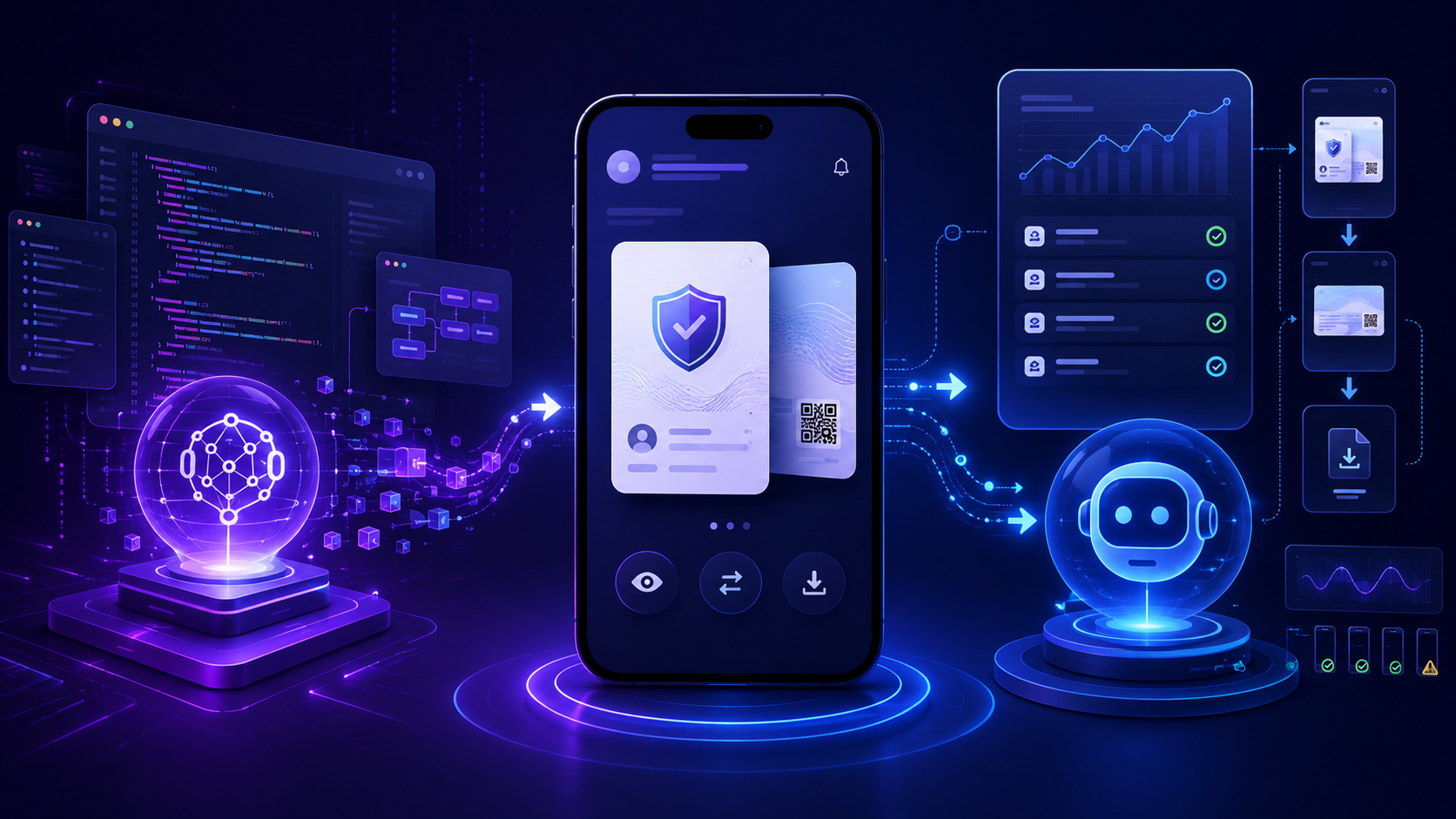
Why Coding Agents Need Independent Verification
Shachar Landshut
Co-founder @ Loadmill | Building agent-based testing (CUA) |
AI coding agents can now inspect repositories, implement features, modify existing code, and reason about whether their changes satisfy a task.
But there is a weakness in asking the same agent to both create the change and decide whether it works.
The agent may evaluate the implementation using the same assumptions it relied on while writing it. If those assumptions are incomplete, the verification step can reproduce the same blind spots rather than challenge them.
A stronger agentic development workflow separates creation from verification.
One agent works with the code. Another independently examines the resulting application behavior.
The Problem With Self-Verification
When a coding agent finishes a task, it can often review the diff, run existing checks, inspect logs, and explain why the implementation should work.
Those steps are useful, but they are not fully independent.
The same model may have:
- Interpreted the original requirement
- Selected the implementation approach
- Written the code
- Chosen which conditions to check
- Evaluated whether those conditions were satisfied
If the original interpretation was wrong, each later step may reinforce that interpretation.
For example, a coding agent implementing a downloadable digital ID card might confirm that:
- The new component exists
- The download function is connected
- The expected state is updated
- The relevant unit tests pass
But those checks do not necessarily prove that a user can open the card, flip it, download it, and find the saved result through the live mobile interface.
The code can look correct while the application behavior is still wrong.
Separate the Builder From the Verifier
Independent verification introduces a deliberate separation of responsibilities.
The coding agent receives the implementation context and builds the feature. A separate testing agent receives the behavior that needs to be validated and interacts with the resulting application.
The verifier does not need to accept the builder’s conclusion that the task succeeded.
It can inspect the project, explore the running application, identify the actual UI behavior, create a focused test, and evaluate the visible outcome.
The basic architecture looks like this:
- A coding agent implements a software change.
- The application is built and made available for testing.
- An independent testing agent examines the relevant context.
- The testing agent generates a focused behavioral test.
- The test runs against the live application.
- The verifier produces execution evidence and a report.
This changes the final question from:
Does the coding agent believe the change works?
to:
Does the resulting application satisfy the intended behavior when independently exercised?
Why Model Diversity Matters
Independence is stronger when the builder and verifier do not share the exact same reasoning path.
Using a different model for verification can introduce another interpretation of the requirement, another way of exploring the interface, and another set of assumptions about what might fail.
This does not guarantee that the verifier will find every defect. It reduces the risk that both agents will repeat the same reasoning mistake.
The goal is not disagreement for its own sake. The goal is to create meaningful separation between:
- Implementation and evaluation
- Code-level reasoning and user-level behavior
- The creator’s assumptions and the verifier’s observations
That separation is the foundation of adversarial verification.
Adversarial Verification in a Mobile Development Workflow
The following demo shows this architecture applied to a newly implemented digital ID card feature in the GreenSure mobile application.
Codex provides the coding context. Loadmill Droid CUA independently inspects the project, explores the running application, identifies the real interface labels and behavior, creates a focused test, executes it on the device, and produces a test report.
Codex provides the implementation context while Droid CUA independently validates the digital ID card through the live GreenSure mobile application.
Verification Should Follow the Real User Journey
The GreenSure example is not limited to checking whether a new screen can be opened.
The intended behavior includes several connected actions:
- Locate the digital ID card feature
- Open the card
- Verify the visible card details
- Flip the card to inspect the alternate view
- Download the card
- Confirm that it was saved for offline access
Each step contributes to the feature’s actual usefulness.
A code-level check may confirm that a download handler exists. A behavioral test verifies that the user can reach it, activate it, and observe the expected result.
This is why independent testing should operate against the running application rather than relying only on the implementation details supplied by the coding agent.
The Verifier Should Discover the Real Interface
Requirements and coding context do not always describe the final interface exactly.
Labels may differ from the original specification. Navigation may have changed. The relevant screen may sit behind a menu or a different user state. A feature can behave correctly in code while remaining difficult or impossible to reach through the product.
An independent mobile testing agent can inspect the application as it exists at runtime.
In the demo, Droid CUA explores the project and the live application before creating the focused test. That allows the test to use the interface and behavior actually present in the product rather than relying entirely on an assumed interaction path.
This runtime discovery is particularly useful when AI-generated changes are produced quickly and the final implementation differs slightly from the initial plan.
Execution Evidence Matters
Independent verification should produce more than another agent’s written opinion.
The result needs evidence that a developer can inspect.
Useful verification output can include:
- The generated test scenario
- The actions performed during execution
- Assertions and their results
- Screenshots of relevant application states
- Failure context
- Execution logs
- A test report
This creates a reviewable boundary between the coding agent and the testing agent.
The builder produces the change. The verifier produces evidence about the behavior of that change.
If the verification fails, the report gives the coding agent or developer concrete information to work from during the next iteration.
Verification Can Become Part of the Agent Loop
Independent verification is most useful when it becomes part of the development workflow rather than a separate demonstration performed after the work is complete.
A possible loop is:
- The coding agent receives a feature request.
- It implements the change.
- The application is built and launched in a test environment.
- The testing agent generates and runs a focused test.
- If the test passes, the result is attached to the change.
- If the test fails, the evidence is returned to the coding agent.
- The coding agent updates the implementation and triggers verification again.
This creates a feedback cycle based on observed application behavior.
The testing agent does not need to rewrite the feature or decide how it should be implemented. Its responsibility is to challenge the result and verify whether the intended behavior is present.
Where Independent Verification Is Most Valuable
This architecture can be useful when an AI coding agent changes behavior that is difficult to validate from code alone.
Examples include:
- New mobile user journeys
- Navigation and menu changes
- Download and offline-access features
- Authentication and account flows
- Permission-dependent behavior
- Localization changes
- Visual state changes
- Multi-step transactions
- Features that cross application and system interfaces
These scenarios benefit from verification at the product-behavior layer.
The implementation may span multiple components, but the verifier can evaluate the same outcome a user experiences.
What Makes the Verification Truly Independent?
Simply invoking another agent does not automatically create meaningful independence.
A stronger verification design should consider:
- Different models: Reduce the chance of repeating the same reasoning patterns.
- Separate responsibilities: Keep implementation decisions away from the verifier where possible.
- Behavioral requirements: Tell the verifier what outcome matters without prescribing every interaction.
- Live execution: Validate the running application rather than only reviewing generated code.
- Explicit assertions: Define observable conditions that determine success or failure.
- Reviewable evidence: Produce reports, logs, screenshots, and reusable tests.
The verifier can use relevant project context, but it should still reach its conclusion from independent execution and observation.
Beyond Self-Reported Success
AI coding agents make software creation faster, but faster creation also increases the importance of reliable verification.
The agent that produced a change can explain its reasoning, inspect its own code, and run predefined checks. Those capabilities are valuable, but they should not be treated as independent proof that the resulting application works.
A separate testing agent creates another line of evidence.
It can approach the software through the live interface, follow the intended user journey, evaluate observable outcomes, and report what actually happened.
That is the practical value of adversarial verification in agentic software development:
One agent builds the software. Another independently verifies the result.
Try Independent Mobile Verification With Droid CUA
Loadmill Droid CUA creates and executes mobile tests from natural-language scenarios against live application interfaces. It can inspect project context, generate focused tests, run them on mobile devices, and produce execution reports.
Use it alongside an AI coding agent to verify newly implemented mobile behavior through an independent testing workflow.
Try Loadmill's Droid CUA
Turn Jira stories, epics, and plain-English requirements into executable flows across web and mobile platforms.
Download now